Your Guide to Dominating Search Engines: Key Elements of SEO Every Business Should Know
April 10, 2026
Updated on 10th April 2026
Most businesses know they need SEO. Fewer understand exactly what makes it work. The difference between sites that dominate search results and those buried on page five often comes down to how well they’ve addressed specific SEO elements—the building blocks that search engines use to evaluate, rank, and display your pages.
At Conversion Century, we’ve structured our SEO audits and campaigns around these elements since 2016. This guide breaks down what they are, why they matter, and how to implement them in a way that actually moves the needle for your business.
What Are SEO Elements?
SEO elements are the core factors that influence how search engines like Google and Bing rank your pages in organic search results. Think of them as the individual components of a larger system—each one contributing to your overall search visibility.
These elements span multiple disciplines within search engine optimization: how your pages are structured, how other sites reference you, how fast your site loads, and how well your content matches what people are actually searching for. Mastering them is essential for any business investing €1,000+ monthly in digital marketing and expecting measurable returns.
The main groups of SEO elements covered in this guide:
On-page elements: Title tags, meta descriptions, headers, internal links, content structure
Analytics elements: Tracking, reporting, and ongoing optimization
Why SEO Elements Matter for Your Business Growth
SEO elements connect directly to business outcomes that matter: qualified organic search traffic, leads, and revenue. When implemented correctly, they reduce your dependency on paid channels and lower customer acquisition costs over time.
Consider this: digital marketing budgets continue growing 10–15% annually, yet most websites still receive little to no meaningful traffic from search. The gap usually comes down to missing or poorly implemented SEO elements—not algorithm secrets or advanced tactics.
From our experience, businesses that consistently address core elements see compounding returns over 6–18 months. We’ve watched clients double their organic traffic simply by fixing technical blockers and filling content gaps that competitors had already covered.
For B2B services, e-commerce, and local businesses, search is often the #1 or #2 revenue channel when these elements work together. The key benefits:
Increased visibility for relevant search queries
Higher trust signals that influence buying decisions
Better conversion rates from intent-matched traffic
Reduced ad spend dependency for sustainable growth
The Major Types of SEO and How Their Elements Fit Together
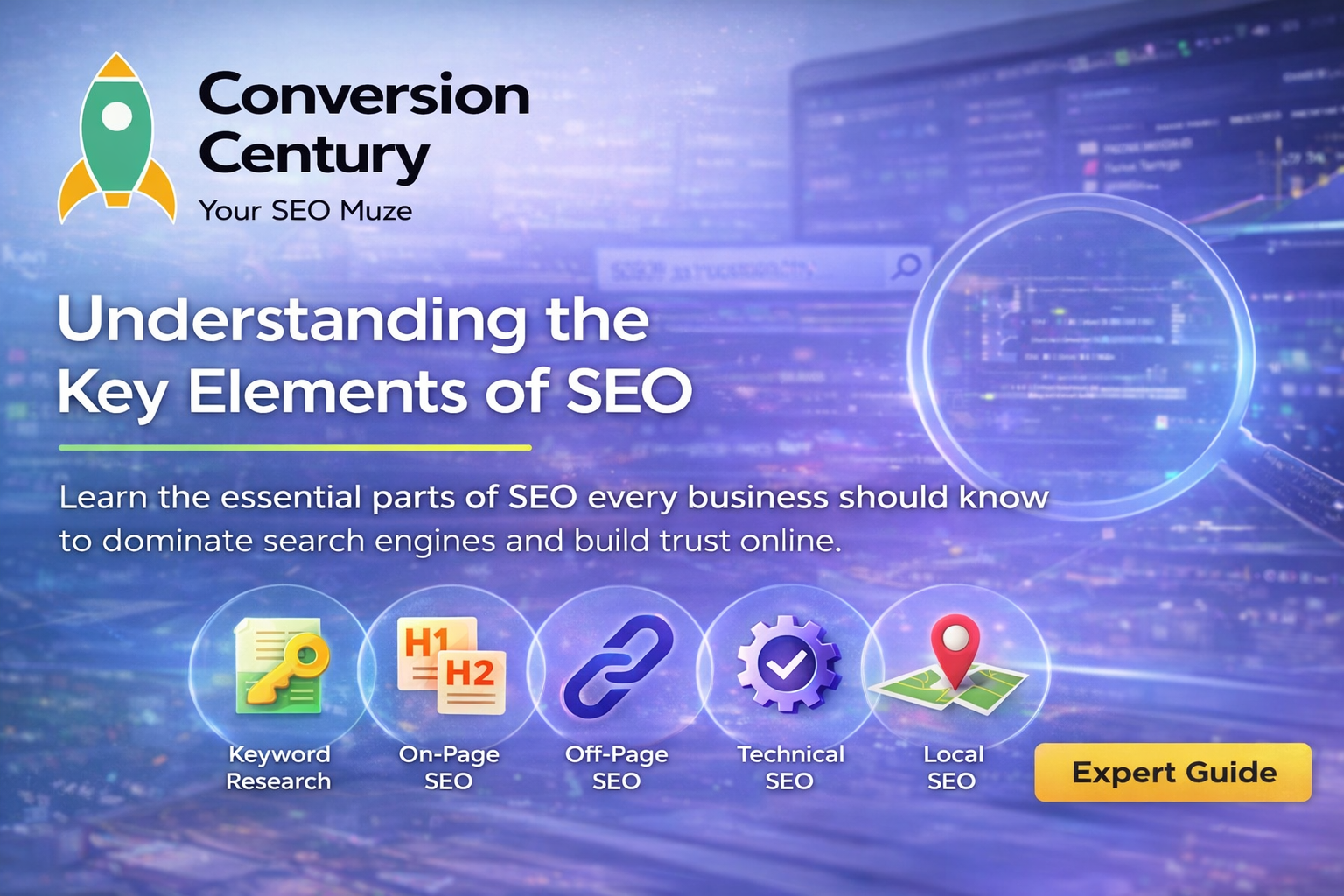
SEO elements become easier to understand when grouped into main types. These aren’t separate silos—they overlap and reinforce each other.
On-page SEO: Elements you control directly on each page (titles, headers, content, internal and external links)
Technical SEO: Infrastructure that allows search engine crawlers to access and understand your site
Local SEO: Location-specific optimization for businesses serving geographic areas
Content SEO: Strategic creation and optimization of content aligned with user intent
At Conversion Century, we structure audits along these types to avoid blind spots. Too many businesses invest heavily in content while ignoring crawl issues, or chase links without fixing the pages those links point to.
These types map roughly to what some call the “Periodic Table of SEO Elements”:
Content: Quality, depth, freshness, relevance
Architecture: Site structure, hierarchy, navigation
Code: HTML elements, schema markup, technical implementation
Performance: Speed, Core Web Vitals, mobile optimization
On-Page SEO Elements (What You Control on Every Page)
On-page elements tell Google exactly what a page is about and who it should rank for. These are the factors you have direct control over—and often the quickest wins available.
Title tags: Keep them 60–65 characters. Front-load your target keyword and include a value proposition. Good example: “Best SaaS CRM Software for Sales Teams | 2024 Guide”. Bad example: “CRM Software | Company Name | Solutions | Tools | Best”
Meta descriptions: Up to 155–160 characters of compelling copy that improves click-through rates. While not a direct ranking factor, better CTR signals relevance to search algorithms
H1–H3 structure: One clear H1 per page containing the primary keyword. Logical subheadings (H2, H3) that reflect search intent and help both users and search engines understand content hierarchy
URL structure: Short, readable, keyword-focused slugs. Use “domain.com/seo-services/technical-seo” not “domain.com/services?id=1234”
Keyword placement: Include relevant keywords naturally in headings, the first 100 words, alt attribute text for images, and conclusions—without stuffing
Internal links: Use descriptive anchor text linking to related pages. This helps search engines understand your site structure and distributes page authority
Content depth and readability: Clear paragraphs, bullet points, short sentences. Make complex topics scannable for busy readers
Content Quality & E-E-A-T as On-Page Elements
Google’s E-E-A-T framework (Experience, Expertise, Authoritativeness, Trustworthiness) has become a significant ranking factor, particularly for content in sensitive niches like health, finance, and legal.
Here’s how to demonstrate E-E-A-T on your pages:
Author bios: Include real credentials, LinkedIn profiles, and industry experience. Anonymous or generic bylines signal lower credibility
Source citations: Link to up-to-date sources (ideally 2022–2026) and original research. This shows your content is grounded in current knowledge
Unique insights: Include case studies, proprietary data, or anonymized client results. Content that only summarizes what others have written won’t compete
Regular updates: Refresh content at least annually with new statistics, screenshots, and examples. Search engines favor content that stays current
Off-Page SEO Elements (Authority, Links & Reputation)
Off-page SEO elements signal to Google that other websites and users trust and recommend your site. These are harder to control directly but essential for competitive rankings.
The core off page seo elements:
Backlinks from authoritative domains: Links from relevant industry blogs, news sites, and respected directories act as votes of confidence. Quality matters far more than quantity—one link from a major industry publication outweighs dozens from irrelevant sites
Anchor text profile: A natural mix of branded anchors (“Conversion Century”), generic anchors (“click here”), and partial-match anchors (“SEO audit services”). Over-optimized anchor text looks manipulative
Digital PR and mentions: Brand mentions in articles, podcasts, and industry roundups build authority even without direct links
Online reviews and ratings: Reviews on Google Business Profile, Trustpilot, G2, and niche platforms influence both rankings and click-through behavior
Social signals: While not direct ranking factors, engagement on social platforms increases content visibility and can generate more traffic
At Conversion Century, we focus on white-hat link building through guest content, partnerships, and resource page placements. We’ve seen too many businesses hurt by acquiring backlinks from irrelevant or low-quality sites—a short-term tactic that creates long-term problems.
Key Off-Page Metrics to Track
Off-page metrics help evaluate progress but shouldn’t become obsessions. They’re directional indicators, not absolute goals.
Domain authority scores (DA, DR): Useful for comparing sites, but these are proprietary estimates from SEO tools—not official Google metrics
Referring domains vs. total backlinks: The number of unique domains linking to you matters more than total link count
Geographic link distribution: For businesses targeting specific regions, the proportion of backlinks from that region affects local relevance
Branded search volume growth: Year-over-year increases in people searching for your brand name indicate growing authority
Technical SEO Elements (Architecture, Code & Performance)
Technical SEO is the infrastructure layer that allows your content and links to actually perform. Without it, even excellent content may never get indexed or ranked.
Crawlability: XML sitemaps updated automatically, robots.txt configured correctly. Improper configuration can block important pages from search engine crawlers entirely
Indexability: Using canonical tags to handle duplicate content, managing noindex tags for internal search results or filter pages
Site architecture: Logical hierarchy (Home → Category → Subcategory → Detail) with pages accessible within 3–4 clicks from the homepage
Mobile-friendliness: Responsive design that works across all devices. Google uses mobile-first indexing, meaning your mobile experience determines rankings
Core Web Vitals: Aim for LCP under 2.5 seconds, CLS under 0.1, and INP under 200 milliseconds. These are confirmed ranking factors
HTTPS and security: Valid SSL certificate, no mixed content issues. Sites without HTTPS are marked “Not Secure” in browsers
Structured data: Schema markup for articles, products, FAQs, and local business information enables rich results in search
Conversion Century includes a technical SEO audit as an early step in most engagements. Site speed issues and crawl problems often explain why good content isn’t ranking.
Technical SEO During Website Migrations
Website migrations—whether changing domains, CMS platforms, or designs—are high-risk moments for losing organic traffic. We’ve seen businesses lose 20–50% of their search traffic due to migration errors that were entirely preventable.
Critical migration elements to protect:
Full URL mapping: Every old URL needs a 301 redirect to its appropriate new destination
Preserve internal linking: Navigation and link structure should be maintained or improved
Maintain metadata: Keep title tags, meta descriptions, and schema markup that’s already performing well
Launch-day verification: Crawl the new site, fix 404 errors, monitor Search Console for index coverage issues, track key keyword rankings daily
Local SEO Elements (For Location-Based Businesses)
Local SEO elements are critical for businesses serving specific geographic areas—plumbers, dentists, regional service providers, or any business with physical locations customers visit.
Google Business Profile (GBP): Complete NAP (Name, Address, Phone), accurate categories, compelling description, quality photos, and regular posts
NAP consistency: Identical business information across your own site, GBP, and all directory listings. Inconsistencies confuse search algorithms
Local citations: Listings on reputable local and industry platforms (chambers of commerce, Better Business Bureau, niche directories). Avoid mass low-quality submissions
Localized on-page elements: Include city/region in title tags, H1s, and content where appropriate. Create dedicated location pages for multiple service areas
Reviews and reputation management: Systematic process for requesting reviews from satisfied customers and responding to all feedback within 24–48 hours
Local link building: Partnerships with local organizations, sponsorships, and local media coverage
Consider a local dental clinic: optimizing these elements can mean the difference between appearing in the map pack when someone searches “dentist near me” or being invisible to potential patients actively looking for services.
Content & Keyword Elements (Search Intent, Topics & Structure)
High-quality content built on solid keyword research forms the foundation of sustainable organic growth. This is where understanding what people searching for your solutions actually type into Google becomes essential.
Keyword research: Discovering topics and search queries your target audience uses at each funnel stage. Use keyword research tools like Google Keyword Planner to build your keyword list
Search intent alignment: Matching content types to searcher intent. Informational queries need educational content; transactional keywords need conversion-focused pages
Topic clusters: Grouping related articles around pillar pages to build topical authority. A “B2B Lead Generation” pillar might link to supporting content on SEO, PPC, and conversion optimization
Content formats: Blog posts for informational queries, landing pages for commercial intent, case studies for social proof, FAQ pages for long tail keywords and voice search
On-page structure: Scannable headings, bullet points, images, and tables that make complex topics digestible
At Conversion Century, we blend SEO data with sales intelligence from clients to prioritize topics with both traffic potential and revenue potential. High search volume means nothing if the traffic doesn’t convert.
Keyword Metrics and Business Potential
Not all keywords deserve equal investment. Understanding keyword metrics helps prioritize limited content resources.
Monthly search volume: Average searches by country. Useful but limited—seasonal and intent variations matter
Keyword difficulty: A rough gauge of competition and effort needed. Low search volume keywords often present underexploited keyword opportunities
Traffic potential: Total traffic a page could receive from all related keywords, not just the primary one
Commercial potential: How closely a keyword aligns with your offer. A high-volume informational query may drive traffic but not leads
Trend analysis: Using historical data to identify rising topics or declining ones from 2020–2026
Example: “What is CRM software” has high volume but mostly informational intent. “Best CRM for sales teams pricing” has lower volume but much higher business potential—these searchers are closer to a buying decision.
The 5 Core Components of a Modern SEO Program
Many businesses search for the “5 components of SEO” seeking a clear framework. Here’s how we structure it at Conversion Century, mapping back to all the elements covered above:
Strategy & research: Market analysis, competitor keyword analysis, target audience definition, and comprehensive keyword research that identifies real keyword ideas worth pursuing
On-page & content: Page-level optimization, creating content aligned with search intent, and improving user experience through better structure and readability
Technical & performance: Crawlability, indexation, Core Web Vitals optimization, security, and the infrastructure that makes everything else work
Authority & reputation: Acquiring backlinks through legitimate off page seo tactics, building brand mentions, managing reviews, and developing domain authority
Measurement & iteration: SEO analytics, rank tracking, competitor analysis, and ongoing optimization based on performance data
This framework keeps campaigns transparent and outcome-focused. Each component connects to specific, measurable SEO elements.
SEO Analytics & Reporting Elements (Measure, Learn, Improve)
Analytics elements transform SEO from guesswork into an ongoing process of measurable improvement. Without proper tracking, you’re optimizing blind.
Baseline benchmarking: Document current organic traffic, conversions, and keyword rankings before starting work. You can’t measure improvement without a starting point
Goal and KPI definition: Define what success looks like—leads, sales, revenue—plus supporting SEO metrics like CTR and user engagement
Tool stack: Google Analytics 4 for traffic and conversion tracking, Search Console for search visibility and click data, plus an SEO platform for competitive analysis and rank tracking
Reporting cadence: Monthly or quarterly reports with year-over-year comparisons where possible. Context matters more than raw numbers
Experimentation: A/B testing titles and meta descriptions, publishing new content formats, measuring impact over 30–90 days before drawing conclusions
Example KPI set for an SME: Increase organic demo requests by 30% in 12 months. This ties back to improving technical elements (so pages get indexed), on-page elements (so they rank), content elements (so they match user intent), and authority elements (so they outrank competitors).
Common Mistakes with SEO Elements (And How to Avoid Them)
Most sites fail due to a few recurring issues, not obscure algorithm secrets or advanced SEO tactics. Here’s what we see most often:
Ignoring technical barriers: Investing in content and links while the site loads slowly, has crawl errors, or serves duplicate content. Fix: Run a technical audit before scaling content production
Chasing low-quality links: Pursuing quantity over quality, acquiring backlinks from irrelevant or spammy other sites. Fix: Focus on earning links from topically relevant, authoritative other websites
Over-optimization: Keyword stuffing, unnatural anchor text profiles, titles that read like keyword lists. Fix: Write for humans first. If it sounds unnatural, it is
Under-optimization: Vague title tags, missing meta descriptions, no internal links, thin content. Fix: Audit pages against on-page element checklists
Neglecting local elements: Ignoring Google Business Profile and local citations when most revenue comes from local customers. Fix: Prioritize local SEO if you serve specific geographic areas
Not measuring results: Continuing the same tactics for 6–12 months despite flat traffic. Fix: Establish baselines, set KPIs, review performance monthly, and adjust strategy based on actionable insights
How Conversion Century Applies These SEO Elements in Client Campaigns
Conversion Century is an SEO agency founded in 2016 in Sofia, Bulgaria. We help SMEs worldwide implement these elements systematically—not as isolated tactics, but as an integrated SEO strategy.
Here’s how a typical engagement works:
Comprehensive SEO audit: We map findings to each element group (on-page, technical, content, links, local where relevant) using multiple SEO tools and manual review
Keyword and content strategy workshop: Aligned with business goals, sales insights, and competitor gap analysis
Implementation roadmap: 3–12 month plans prioritizing technical fixes and high-impact content first
Ongoing authority building: White-hat link acquisition through partnerships, guest content, and digital PR
Monthly or quarterly reporting: With clear SERP features tracking, ranking movement, and business impact metrics
Example: A B2B SaaS client came to us with stagnant organic traffic despite publishing content for years. Our audit revealed crawl issues blocking 30% of their pages, plus content that didn’t match commercial search intent. Over 11 months, we fixed architecture problems, launched pillar content targeting high-intent terms, and built industry backlinks. Result: doubled organic demo requests.
Next Steps: Putting SEO Elements into Action
Understanding SEO elements is only valuable when turned into a prioritized action plan. The businesses that win in search treat optimization as an ongoing process, not a one-time project.
Here’s a simple action checklist to start:
Audit your current site against the main element groups using Google Search Console, a search console account, and internal knowledge of your content
Prioritize fixes by impact and effort: Start with technical blockers and pages closest to generating revenue
Build a 3–6 month content plan focused on core business topics, specific keywords with proven search behavior, and gaps identified in competitor analysis
Set clear KPIs and a reporting cadence to review progress with your team or agency partner
Measure, learn, adjust: SEO success comes from iteration, not set-and-forget tactics
Ready to see how these elements apply to your specific situation? Conversion Century offers a free SEO consultation where we review your current elements and outline a practical roadmap for growth. No generic advice—just strategic recommendations based on what’s actually happening with your site.
Book your free consultation and let’s build an SEO foundation that drives more traffic, leads, and revenue for your business.







.svg)


